
Cocoa flooding: ‘Everything was floating’ as residents rescued from homes amid record St. Johns River flooding
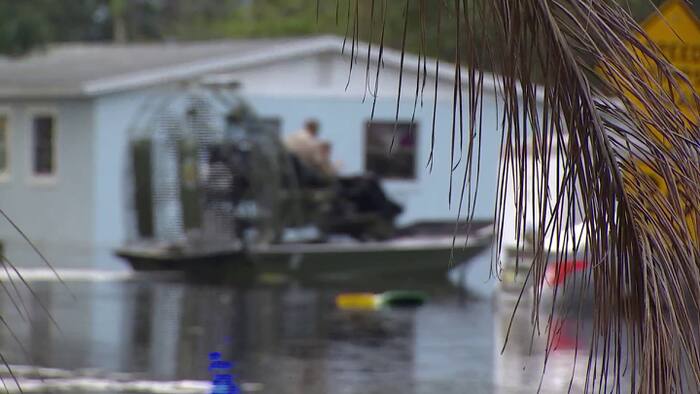
The streets look more like rivers. Cars sit partially submerged in murky water. Airboats navigate residential neighborhoods, helping people escape homes they no longer feel safe inside.
For some Brevard County families, the place they once turned to for comfort has become the source of their greatest uncertainty.
Record flooding has forced residents from their homes, destroyed belongings and left some neighborhoods accessible only by boat.
Among those rescued Friday was Christine Andrews, who spent the previous night inside her flooded home as the water continued rising.
“I tried to stick it out, but it was getting bad,” Andrews told News 6 shortly after reaching safety.
“I stayed the night, but mostly in my room on my bed, ‘cause my bed’s high enough, but everything else is floating in the house.”
Andrews said she initially believed she could ride out the flooding. But the water continued rising, spreading through her home and leaving her increasingly concerned about whether she could safely escape.
She said she also stayed behind because she did not want to abandon an older man who lived in the home with her. His son eventually came to get him.
By the time Andrews left, she said she was the last person remaining.
When asked what she believed she had lost, her answer was brief.
“Everything. Everything.”
Andrews described belongings floating inside her home and said the flooding had reached the tops of some of her possessions.
She managed to leave with only a few necessities, including clothes, a toothbrush and toothpaste.
“I’m just glad to be out,” Andrews said.
She worries it could be months before she can return.
“I’m glad to be safe over here,” she said, while also expressing concern for the neighbors who have suffered similar losses.
“Some people don’t even know where to start.”
Residents describe frightening moments as water rushed into homes
For another Brevard County homeowner, the flooding became an emergency in the middle of the night.
She told News 6 she woke up around 4 a.m. Thursday and discovered approximately eight inches of water inside her home, despite having no standing water indoors the night before.
The situation rapidly deteriorated.
“The water was just rushing in at us,” she said.
Her young son became frightened as the water spread throughout the home.
“He’s like, ‘Mommy, help me. Get me out of here. Get rid of the water,’” she recalled.
The mother said she struggled to explain what was happening to her child, who wanted to return to the only home he knew.
“He wants to go back home, but I tell him we don’t have a home no more. It’s awful.”
She said the flooding left furniture, appliances and vehicles damaged, with water reaching knee level in parts of the home.
The family is now staying with relatives while she tries to determine how to rebuild.
“What am I gonna do? Like, how am I gonna get back on my feet?” she asked.
She said she is especially concerned about finding transportation, keeping her job and securing another place to live. She also told News 6 she does not have flood insurance.
Airboats replace cars on flooded neighborhood streets
The extraordinary conditions have forced first responders to use specialized equipment to reach residents trapped by rising water.
News 6 cameras captured Florida Fish and Wildlife Conservation Commission officers using airboats to travel through flooded residential streets, help residents evacuate and transport people toward dry ground.
Other residents could be seen walking through deep water while carrying belongings they managed to save.
FWC Lt. Grant Eller described the situation as catastrophic for the affected area.
“It’s an event that we haven’t had in quite a long time,” Eller told News 6.
He said approximately 80 FWC officers and 13 airboats had been deployed to the area as part of the response, with crews working alongside the Brevard County Sheriff’s Office, Florida Highway Patrol and Florida National Guard.
“A lot of folks have been trapped in their house with their pets,” Eller said.
He explained that crews were helping people gather essential belongings before transporting them to buses, shelters or waiting family members.
For some responders, the greatest challenge has been persuading residents to leave.
Eller said many homeowners initially hoped the floodwaters would recede before making the difficult decision to evacuate.
“Sometimes it’s just convincing people that they should leave their homes,” he said.
FWC told News 6 around 4 p.m. Friday that approximately 120 people had been rescued in Brevard County, while well over 150 people had been rescued in Volusia County.
Those figures were the latest county-specific estimates provided directly to News 6 on Friday afternoon. A newer official rescue total was not independently confirmed Friday evening.
A November 19 state emergency-management release said approximately 235 FWC officers had responded across affected Florida communities, supported by 17 airboats, 26 shallow-draft boats, 28 all-terrain and utility vehicles, and eight swamp buggies.
Florida National Guard personnel have also been conducting high-water rescue operations. Guard members assigned to Bravo Battery, 1st Battalion, 260th Air Defense Artillery Regiment, were documented assisting with rescue operations in Rockledge early Friday.
Some families remain stranded despite escaping damage
Not every resident has experienced flooding inside their home, but the rising water has left some people effectively isolated.
Jermaine Wilson, who lives with his 62-year-old mother, said floodwater spread through his neighborhood with alarming speed.
“Overnight,” Wilson said when asked how quickly conditions changed.
Although his home sits on higher ground, he said the surrounding water has made it difficult to leave.
“Stranded. Can’t go nowhere,” Wilson said.
He estimated that in approximately an hour, water had advanced as far as halfway up his driveway.
When asked whether he could leave the property, his answer was simple.
“In a boat, yeah.”
Wilson said he and his mother helped a driver whose vehicle became stuck in floodwater. He also described neighbors helping one another and emergency responders moving through the community.
Despite the circumstances, Wilson remained hopeful.
“Just hope for the best, and I just … hope everybody’s good and safe pretty much.”
St. Johns River breaks historic flooding record near Cocoa
The flooding comes as the St. Johns River reaches levels never previously documented at the National Weather Service’s Cocoa monitoring gauge.
According to the National Weather Service in Melbourne, the river stood at 18.7 feet at 8:15 p.m. Friday, with a maximum reading of 18.8 feet during the previous 24 hours.
The river’s major flood stage begins at 17 feet.
The river surpassed its previous record, set in 1953, and forecasters expect levels to remain near 18.8 feet through the weekend and into early next week.
The NWS has identified several neighborhoods particularly vulnerable to flooding, including the Lake Poinsett area west of Cocoa, Silver Pines in Rockledge and Shakespeare Park in Cocoa.
The agency also warns that flooding could make Providence Road impassable and restrict access to homes near Mullet Lane and Bass Road.
The river’s official gauge level represents its elevation relative to a measurement reference point, not the depth of water inside homes or across neighborhood streets.
Even as rainfall diminishes, the flooding threat is far from over.
Water management district holding 60 billion gallons of floodwater
The St. Johns River Water Management District says its flood-control system is temporarily storing approximately 60 billion gallons of water in the Upper St. Johns River Basin that would otherwise be flowing downstream.
In a November 20 statement, the district said its network of reservoirs, canals and water-control structures is operating as designed to reduce downstream flooding impacts.
The district explained that the St. Johns River flows across an exceptionally flat landscape, descending only about one inch per mile.
That gradual slope means floodwater moves slowly through the system, allowing river levels to remain elevated long after heavy rainfall ends.
The district also announced controlled releases through the S-96 structure into the C-54 Canal. Those operations divert some water that would ordinarily move toward the St. Johns River through the Three Forks Marsh area into a canal system that ultimately discharges into the Indian River Lagoon.
Officials say the releases follow a federally approved water-management plan designed to balance flood protection and environmental considerations.
The district says the controlled releases are being used to help manage the extraordinary volume of water in the upper basin.
But the challenges extend well beyond Brevard County.
In a separate Friday statement, officials warned that stretches of the St. Johns River farther north have not yet crested.
Strong northeast winds could slow drainage through Saturday, while king tides beginning Sunday could contribute to higher water levels in tidal portions of the river.
The district cautioned that it could take months for some sections of the St. Johns River to fall below moderate flood stage.
Volusia County prepares for additional flooding
Communities farther north along the St. Johns River are also facing an increasing threat.
Volusia County officials declared a local state of emergency as crews continued responding to flooded roads, stranded residents and hazardous travel conditions.
The county warned Friday that major flooding is possible near DeLand, Astor and portions of the river near Lake Harney, with some locations potentially reaching record levels.
Officials are particularly concerned about low-lying homes, riverfront properties and neighborhood roads that could become inaccessible.
The county’s emergency declaration provides additional authority to coordinate resources and respond to the ongoing flooding.
Residents can find the latest information through Volusia County’s official emergency updates.
Where Brevard County residents can find help
Brevard County Emergency Management has opened two emergency shelters for people who need somewhere safe to stay.
Walter Butler Community Center4201 N. Cocoa Blvd.Cocoa, FL 32927
Joseph N. Davis Community Center2547 Bruce D. Buggs StreetMelbourne, FL 32901
The shelters are open to the general population, people with special medical needs and families with pets, according to the county.
Residents should bring necessary medications, changes of clothing, personal hygiene items, bedding and other essential supplies.
The county is also collecting damage reports from homeowners affected by flooding.
Residents can submit photographs and descriptions of flood damage through Brevard County’s online reporting system.
Officials emphasize that the damage-reporting form is not an application for financial assistance. It helps emergency managers document impacts and coordinate recovery efforts.
Multi-Agency Resource Centers are also available to connect flood survivors with assistance at:
- Tony Rosa Community Center, 1502 Port Malabar Blvd. NE, Palm Bay.
- Veterans Memorial Complex, 2285 Minton Road, West Melbourne.
The county lists hours of 8 a.m. to 7 p.m. daily for those centers.
Residents can call 2-1-1 for community assistance and recovery information.
Emergency Management is also reminding residents not to drive through flooded roadways or enter standing floodwater, which can contain sewage, chemicals, debris and other hidden hazards.
For continued updates, residents can visit the Brevard County Storm Center or sign up for emergency alerts by texting BREVARDEOC to 888777.
A long recovery ahead
For the residents forced to leave their homes, the threat does not end when the water finally begins to recede.
Andrews said she expects it could be months before she can return to her home.
Others are struggling to determine what can be salvaged, how damaged belongings will be replaced and where their families will live.
For many, even a basic sense of normalcy now feels far away.
Andrews said she is grateful to have family members who can help her through the coming days.
“We’re gonna figure it out,” she said. “We’ll figure it out.”
As emergency crews continue navigating flooded streets and helping residents reach safety, the longer-term questions remain: when will families be able to return home, and what will be waiting for them when they do?