
Dollars & Sense: FSA vs. HSA – Two Very Different Accounts, Two Very Different Sets of Rules
What to Know:
- Both FSAs and HSAs let consumers use pre-tax money for eligible health expenses.
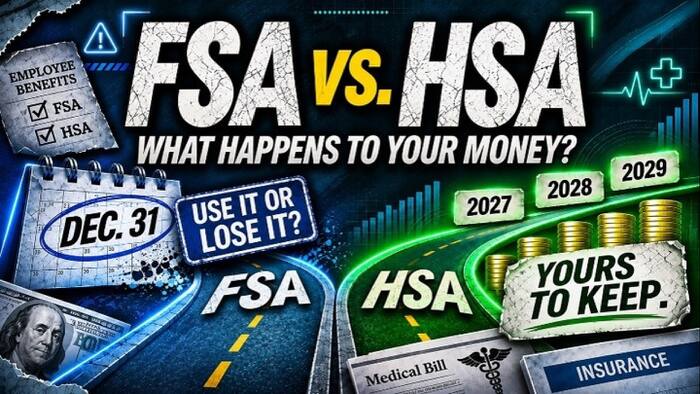
- The biggest difference is what happens to unused money: FSA balances may be forfeited, while HSA money belongs to you and rolls over indefinitely.
- Not everyone qualifies for an HSA: you generally need an HSA-eligible health insurance plan.
- In most cases you can’t have both an FSA and an HSA – and once you’re on Medicare, HSA contributions stop.
ORLANDO, Fla. – Welcome to November in Florida! The weather is finally cooperating, the holidays are just around the corner, and for a few glorious moments, it feels like one of the best times of the year as we coast into Thanksgiving, Christmas, and the New Year.
Then comes the realization that November also means open enrollment season. Because nothing says “holiday spirit” quite like looking at rising insurance costs and comparing deductibles, copays, and spending accounts.
Aside from picking the best insurance to meet the needs of your family, for millions of American workers, open enrollment also means it’s time to confront two health-care acronyms that sound remarkably similar: FSA and HSA.
Both can help you pay medical expenses with tax-advantaged dollars. Both may come with a debit card you can use at the doctor’s office or pharmacy. And both can potentially lower your taxable income.
But that is about where the similarities end.
FSA vs. HSA
At their most basic, both FSAs and HSAs allow you to set aside money for qualified medical expenses while getting a tax break. In many cases, you decide how much to set aside for the year with the amount coming out of your paycheck before federal income taxes – and in most cases Social Security and Medicare taxes – are calculated.
In turn, you save money by reducing your taxable income. You can then use those pre-tax dollars to help pay for eligible health expenses such as deductibles, copays, prescriptions, dental care, and vision expenses. And here in Florida, with no state income tax, that federal savings is the whole ballgame.
That’s the basics, but as with many things, the devil is in the details.
FSA is the acronym for Flexible Spending Account; HSA is the acronym for a Health Savings Account.
The simplest way to think about the difference between the two:
- FSA: Generally, use it or lose it.
- HSA: Use it, invest it, or take it with you.
How does an FSA work?
A health FSA is typically offered as part of an employer’s benefits package. Workers decide how much money they want to contribute for the year and that money is generally deducted from their paychecks before federal income taxes are calculated.
Note: this story is about health FSAs. Some employers also offer a dependent care FSA for childcare costs – different account, different rules, and a separate $7,500 limit for 2027.
The money can then be used for qualified medical expenses, including many deductibles, copayments, prescriptions, dental expenses, and vision care.
For 2027, employees can contribute as much as $3,500 to a health FSA, up from $3,400 in 2026 (according to the Internal Revenue Service). But FSAs come with an important caveat: they are generally considered “use-it-or-lose-it” accounts.
For plans beginning in 2027, employers that allow a carryover can permit as much as $700 in unused FSA money to carry into the next year (up from $680 in 2026). The IRS has allowed FSA carryovers since 2013, but employers have the final say in what they want to offer: they can allow employees to carry over the full $700, a smaller amount, or nothing at all.
You could also be forgiven for assuming a 2027 FSA only covers expenses for the 2027 calendar year. Not so fast: some employers may give workers additional time after the plan year ends to spend unused money. The IRS says an FSA may offer either a grace period of as much as 2½ months or a carryover, but not both.
And that makes estimating your expenses important.
There is also one very big potential advantage of an FSA if you expect a large medical bill early in the year: with a health FSA, the full amount you elect for the year is generally available from the beginning of the coverage period, even before all of that money has been deducted from your paychecks. For example, if you elect $3,000 for the year and face a $2,500 eligible medical expense in January, you generally do not have to wait for $2,500 to accumulate through payroll deductions.
An FSA sounds like a pretty good deal: set aside money you already expect to spend on health care, pay those bills with pre-tax dollars, and lower your taxable income in the process.
Which leads to a logical question: what’s the FSA gamble?
Put too little money into an FSA, and you may miss out on some potential tax savings. Put too much in, and depending on your employer’s rules, you could eventually forfeit some of the money. And there’s one more thing: leave your job midyear, and any FSA money you haven’t spent is generally gone.
How is an HSA different?
On the surface, an HSA looks very similar to an FSA, but in reality, it works very differently. First, you cannot simply choose to open one because you like the benefits. To contribute to an HSA, you generally must be enrolled in a health insurance plan that meets federal requirements for an HSA-eligible high-deductible health plan and meet the other eligibility requirements.
And in most cases, you can’t have both.
A regular health FSA – including one through your spouse’s employer – generally disqualifies you from contributing to an HSA. The exception: a limited-purpose FSA that covers only dental and vision.
With that said, for HSA participants, two words are especially important: high deductible. For 2027, the IRS says an HSA-eligible high-deductible health plan must meet these thresholds:
- A minimum deductible of $1,750 for self-only coverage.
- A minimum deductible of $3,500 for family coverage.
- An out-of-pocket maximum no higher than $8,700 for self-only coverage or $17,400 for family coverage.
If you qualify, the 2027 HSA contribution limits are:
- $4,500 for self-only coverage.
- $9,000 for family coverage.
- Those limits are up from $4,400 and $8,750, respectively, in 2026.
- Any money your employer puts in counts toward those limits.
- If you’re 55 or older, you can contribute an extra $1,000.
Working past 65? Once you enroll in Medicare – even just Part A – you can no longer contribute to an HSA. You can still spend what’s already there. And Part A coverage can be backdated up to six months when you sign up late, so many advisers suggest stopping contributions ahead of time.
There’s also a new wrinkle for 2026 and beyond for marketplace participants: under last year’s federal tax law, bronze and catastrophic plans sold on the ACA marketplace can now be paired with an HSA. That matters in Florida – the state leads the nation in marketplace enrollment.
The money in an HSA is yours
This may be the most important distinction between an FSA and an HSA. Money contributed to an HSA belongs to the account holder.
- If you do not spend it this year, it remains in the account.
- If you change jobs, it goes with you.
- And unlike an FSA, there is no annual “use-it-or-lose-it” deadline.
The IRS describes an HSA as an account owned by the qualified individual and says employer contributions to an employee’s HSA become the employee’s property.
That allows an HSA to serve two purposes: it can be a spending account of sorts for today’s medical expenses, or, for people who can afford to pay some medical costs from other funds, it can become a longer-term savings account for future health expenses.
Depending on the HSA provider, account holders may also be able to invest some of the money. That can make the tax treatment particularly valuable: contributions can receive a tax advantage, investment earnings can potentially grow tax-free, and withdrawals used for qualified medical expenses can also be tax-free.
But that money comes with strings. Use it for something other than qualified medical expenses before age 65, and you’ll owe income tax plus a 20% penalty. After 65, the penalty goes away – you’ll just pay income tax, much like a traditional IRA.
So, what’s the HSA gamble?
Choose an HSA-eligible high-deductible health plan, and you may gain access to a powerful savings tool that lets unused money roll over and potentially grow for years. But the tradeoff is that you may have to pay more out of pocket before your insurance begins covering a larger share of your medical costs.
This or that?
OK – which is better? There is no single answer.
An FSA can make sense for someone with relatively predictable medical expenses who wants to set aside money for those costs and reduce taxable income. The important part is estimating those expenses carefully and understanding the employer’s rules for money left in the account at the end of the year.
An HSA may appeal to someone enrolled in an eligible health plan who wants the ability to accumulate money for future medical expenses. But the HSA should not be the only reason to select a particular insurance plan: high-deductible plans can leave consumers responsible for considerably more of their medical expenses before insurance begins paying its share.
Someone who regularly visits specialists, takes expensive medications, expects surgery, or has other significant health-care costs may have very different needs from someone who rarely uses medical care.
That means consumers should look at the entire health plan – including premiums, deductibles, copayments, coinsurance, prescription coverage, provider networks, and the maximum amount they could have to pay out of pocket – then look at the account that comes with it.
Despite two acronyms separated by only one letter, an FSA and an HSA are not interchangeable. The easiest way for you to choose which is right for you: do your homework. Because when it comes to health care, that one letter can make a big difference in what you spend, what you save, and what you get to keep.