
‘Haven’t we had enough?’ Florida Gov. DeSantis reveals simple plan to lower inflation
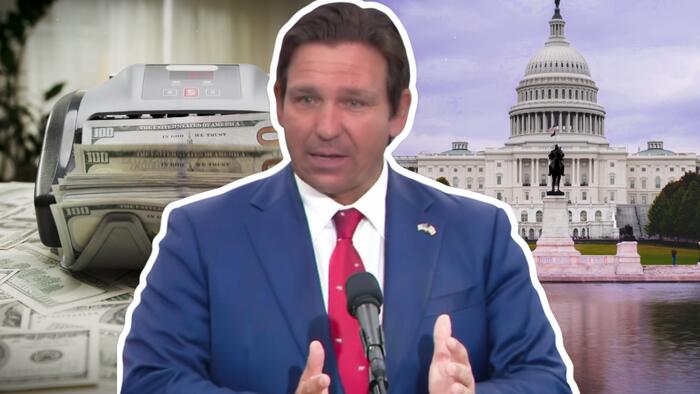
Inflation has been a persistent issue for many Americans, rising by more than 60% over the past two decades, according to the U.S. Bureau of Labor Statistics.
In response, experts expect the Federal Reserve to hike interest rates next month to cool recent inflation rates — though Florida Gov. Ron DeSantis shared his perspective on how else the government may address this issue.
It began on Sunday when Pershing Square CEO Bill Ackman discussed the potential rate hike, calling out the Federal Reserve’s 2% inflation threshold and arguing for a 3% goalpost instead.
[RELATED: Here’s how inflation works — and who’s responsible]
“The Fed will put the U.S. and world in recession if it continues to raise rates in a failed attempt to drive inflation to 2%,” he claimed.
I think the Fed is about to make another mistake on December 9th. Financial conditions have tightened massively. For example, @SpaceX, an investment grade company, just raised secured debt financing at an 8.259% interest rate versus below 6% for its unsecured bond offering at the time of its IPO.
The cost of equity capital has also increased materially with the recent substantial decline in the stock market.
The Fed’s 2% inflation ambition is misguided. Geopolitical risk and the required investment in global military spending, de globalization and tariffs, and the massive AI infrastructure and related energy investment are features of the world that did not exist when the 2% target was set. 3% inflation is a more realistic ambition in the new world.
The Fed will put the U.S. and world in recession if it continues to raise rates in a failed attempt to drive inflation to 2%.
Tell me why I am wrong.
— Bill Ackman (@BillAckman) November 22, 2026
The Federal Reserve aims to keep inflation rates at about 2% yearly, which many economists argue helps keep the economy growing.
However, this also causes prices to rise across the board, improving the value of investments but making everyday goods less affordable for many — an issue that DeSantis pointed out in his own X post on Monday.
This would preference those with assets (stocks, real estate, etc) over those who rely on income and savings.
Asset-rich, income-poor economy.
Haven’t we had enough of that since post-2008?
— Ron DeSantis (@RonDeSantis) November 23, 2026
As such, another user asked DeSantis what his plan to address the problem would entail. DeSantis responded accordingly:
“Less borrowing and spending.”
I agree. A rate hike won’t cure the underlying problems. Need spending/borrowing reform.
— Ron DeSantis (@RonDeSantis) November 23, 2026
DeSantis has long been a proponent of federal fiscal conservatism, pushing a “Balanced Budget Amendment” amendment that would require the U.S. Congress to balance it budget each year.
The idea is to limit lawmakers’ spending to avoid further growth of the national debt, though less spending could also result in lower inflation.
So far, over 20 states have already signed on.
WHAT EXACTLY IS INFLATION?
Inflation occurs when money loses its value, causing prices to rise across the board.
To understand inflation, it’s important to understand supply and demand.
To keep it simple: when there are fewer people demanding a good or service, the price for that good/service falls. The same is true of supply; when there is less of a good or service, the price rises.
The graph below demonstrates how this works.
While many economists quibble over what exactly qualifies as inflation, the consensus is that inflation goes up as more money enters the economy.
After all, when the supply of currency increases, the “price” (i.e. value) decreases.
HOW COVID-19 WORSENED INFLATION
Thanks to lockdowns amid the COVID-19 pandemic, many people were forced to stay at home. During this time, the federal government spent trillions through the Cares Act and other spending bills to keep the economy afloat.
When lockdowns were finally lifted and people were allowed to go back outside, consumer spending skyrocketed. Thanks to the lockdowns, many businesses were still unable to accommodate this massive flux in demand (meaning there was less supply), causing prices to soar, as well.
“When we came to our senses and started opening the economy back up, there was just — not just for gasoline and oil but for a variety of goods and services — just an explosion of demand,” UCF economist Sean Snaith told News 6 back in 2024.
With so much more money in circulation and so many supply shocks slowing production, it resulted in a huge swell of inflation, reaching 9.1% in June 2022. Those sorts of figures hadn’t been seen in roughly 40 years.
While inflation in 2026 has still been above target levels, it has slowed down compared to 2022. As of September 2026, the year-over-year rate was 3.7%, BLS data shows.
INFLATION IS COOLING
While the rate of inflation has cooled since 2022, overall inflation is still up. And it’s still growing.
Of course, that’s all by design.
The Federal Reserve aims to keep the rate of inflation at around 2%. The primary means that the Federal Reserve says it uses to achieves this are manipulating interest rates and increasing the money supply.
- INTEREST RATES: When the Federal Reserve lowers interest rates, it makes the cost of borrowing money cheaper. This can encourage more people to take out loans, which means that more money is being spent within the economy. Conversely, when inflation becomes too much to handle, the Federal Reserve may increase rates to discourage borrowing.
- MORE MONEY: The Federal Reserve doesn’t simply print cash to add to the economy. Instead, it can essentially create currency digitally. To do so, it engages in “quantitative easing” — creating new bank reserves on its balance sheet to buy up assets like Treasury securities (which help fund the federal government) and corporate debt.
WHY DOES THE FEDERAL RESERVE WANT MORE INFLATION?
According to the Federal Reserve itself, the whole idea behind keeping inflation up — that is, more spending — is that it helps motivate production.
The logic goes that when people are spending their money on goods and services, it motivates sellers to ramp up production on these goods and services to better meet market demand, thus growing the economy.
As a result, government spending, quantitative easing and lowered interest rates can be used to stimulate economic growth in the short term.
However, the main problems that critics point to are twofold:
- REDUCED SPENDING POWER: As more fiat currency (i.e. money like the U.S. dollar that is backed solely by faith in the government) is added to the economy, the value of that currency goes down. That means you have to spend more money to acquire the same amount of goods that you could before — hence, inflation.
- MALINVESTMENT: If the government or private firms put more money into the wrong types of projects (those with low market demand), that money could end up being wasted, ultimately becoming a drain on the resources used to make that investment.
“The government shouldn’t be picking winners and losers in the economy,” Snaith explained. “Throughout history, governments are notoriously bad at making those decisions, and that’s why markets are the most efficient way we have on this planet to allocate resources.”
THE TRADE-OFF
On the other hand, reducing inflation would require deflation, meaning that people are spending less money, which further means that sellers are producing fewer goods/services.
“That trade-off is sort of highlight between inflation and the unemployment rate,” Snaith explained. “If you want to bring inflation down, the unemployment rate needs to rise, and vice-versa.”
This process helps to bring down price levels, though it could involve recessions or — if bad enough — depressions, which is why the Federal Reserve seeks to avoid it. Proponents of quantitative easing argue that this is a critical role upheld by the bank.
But can the Federal Reserve keep economic growth going indefinitely?
“The central bank is not omniscient,” Snaith told News 6. “Obviously, they’ve got a legion of economists trying to predict the economy. But anybody that’s in the prediction business knows that mistakes and predictions about anything are part of the process.”
HOW DOES THIS IMPACT MY SAVINGS?
All of the inflation that’s happened so far isn’t going away. It’s now baked into the price tags you see during a trip to the grocery store.
But even worse than that, it’s chipping away at your savings.
As you might have picked up on by this point, as inflation rises, it means that the value of money goes down. Thanks to this, the money you’ve saved is losing its value over time as inflation continues to increase.
For example: if inflation stays consistent at 2% per year, then $100,000 now will be worth just under $60,000 by 2050. And only around $40,000 by 2070, when many young people today would otherwise be able to plan for retirement.
WHAT CAN YOU DO ABOUT THIS?
An effective way to circumvent this sort of issue is by investing money into financial or physical assets — things like real estate, stocks, precious metals, high-value savings accounts, or other types of securities — to better hedge against inflation.
“This is why things like gold become more popular when there’s inflation,” Snaith explained. “Because it’s a real asset whose value will rise in a way to offset any effects of inflation.”
Regardless, Snaith assures that when left to their own devices, markets will eventually correct themselves.
“But how long is that going to take, right?” he said.