
Inside the Chinese factory building humanoid robots for the world
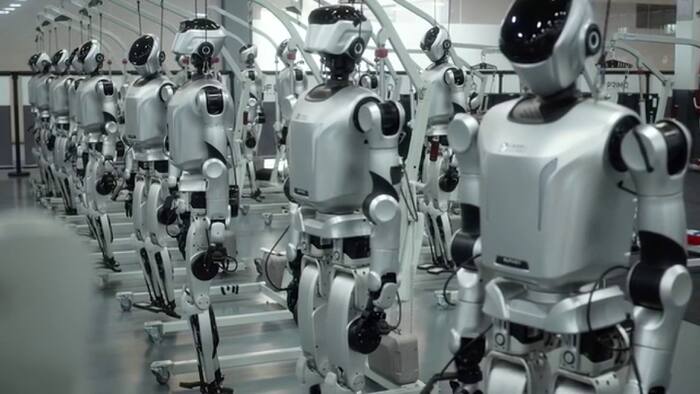
Humanoid robots are breaking marathon records, performing backflips before crowds, and squaring off in MMA-style bouts. Now, CNN is getting a rare look at where some of them are made.
CNN reporter Dhruv Tikekar walked the assembly line at Leju Robotics’ facility in Foshan, China — the first time the network has been granted this kind of access to a robotics company’s production floor in the country.
A factory built for scale
The facility, operated by Leju Robotics and its partner Dongfang Precision Group, spans 15,000 square meters and produces three distinct humanoid robot models. It launched in March 2026 with an ambitious target: up to 10,000 units per year.
The joint venture is called DF Primo. Engineering Director Huhehanggai served as CNN’s guide through the sprawling space, walking past robots hanging in test rigs, others planted on the ground going through movement checks, and shelves staged with components waiting for assembly.
“Humanoid robots will become like a tool that everyone can use,” Huhehanggai said.
What the robots can — and can’t — do on their own
Not every robot at the facility walks on two legs. The Huavo 5 W, one of the models on the floor, rolls on two wheels and is built primarily for industrial settings.
Robots that have cleared their quality checks wait in a staging area before moving to the warehouse. Those still in testing go through a battery of movement evaluations — walking, dancing, and other specific actions — to identify connection or function problems before leaving the facility, Huhehanggai explained.
Once a robot ships to a customer, Leju’s direct role ends. The company’s machines rely on customer programming and onboard sensors to function in the real world.
Those sensors are the brains of the operation — literally. Tikekar handled the detached head of a robot used for educational purposes and found it surprisingly heavy, despite containing no processing hardware. The head houses cameras and sensors that help the robot orient itself in a space.
The challenge isn’t building one robot
With more than 1,000 components in each unit, quality consistency is the company’s biggest engineering hurdle.
“To produce one robot is not a challenge,” Huhehanggai said. “But how to produce 10,000 robots with the same standard — it’s a challenge.”