
A water dispute between two Central Florida cities: How Apopka plans to fix a multimillion-gallon problem
A construction sign, heavy equipment and small purple utility flags mark the site of an infrastructure project in northwest Apopka. But behind the work underway at the Golden Gem Reclaimed Water Facility is a disagreement involving two Central Florida cities, a decades-long agreement and millions of gallons of water that Apopka acknowledges its infrastructure has struggled to handle.
Earlier this year, Altamonte Springs sent Apopka a certified letter accusing the city of repeatedly requesting reductions or interruptions in reclaimed-water deliveries, arguing those actions violated a water-sharing agreement signed in 2013.
Now, following months of discussions and a renewed push to improve Apopka’s infrastructure, officials from both cities tell News 6 their relationship has improved significantly.
The potential solution centers on the Golden Gem facility, where construction is underway on pumping infrastructure designed to help Apopka better manage its growing reclaimed-water demands.
Once the improvements are operational, officials say the facility will give the city’s distribution system access to more than 300 million gallons of additional storage capacity.
That is a substantial amount of water, but Apopka officials say the problem has never been as simple as obtaining enough water. It is also about having the infrastructure necessary to store it and move it where residents need it.
A 50-year agreement becomes a source of conflict
The dispute traces back to June 19, 2013, when Apopka and Altamonte Springs entered into a 50-year agreement governing the delivery of reclaimed water between the two communities.
Under the agreement, Altamonte Springs would provide, and Apopka would accept, up to 4.5 million gallons of reclaimed water per day, measured on an annual average basis.
The arrangement also allows deliveries of up to 7 million gallons on a particular day without additional written approval from Apopka.
The reclaimed water itself is supplied at no charge, although the agreement assigns infrastructure responsibilities to the participating cities.
The arrangement was designed to benefit both communities.
Altamonte Springs could redirect excess treated water into a neighboring utility system, while Apopka could supplement its own reclaimed-water supply, support future development and reduce its reliance on groundwater.
However, according to a certified letter dated January 27, 2026, Altamonte Springs officials grew increasingly frustrated with what they described as repeated requests from Apopka to reduce or stop accepting water.
The letter, sent by Altamonte Springs City Attorney Mary Sneed to Apopka’s then-mayor Bryan Nelson, alleged that the interruptions dated back to October 2018.
It also identified additional requests to reduce water deliveries in December 2025.
Altamonte Springs argued that the agreement did not authorize Apopka to unilaterally restrict deliveries and warned that those actions were creating significant operational difficulties.
In particularly direct language, the letter stated:
“Altamonte simply cannot allow these unilateral actions by Apopka to continue.”
The city also warned that it would no longer honor Apopka’s requests to reduce or stop the flow of reclaimed water and sought a plan for meeting the agreement’s requirements.
The January letter represented a serious escalation in the disagreement. However, its accusations were Altamonte Springs’ position at the time, not a court determination that Apopka violated the agreement.
Why the dispute extended beyond water deliveries
According to the certified letter, Altamonte Springs was concerned about more than the inconvenience of having to redirect excess water.
The city argued that sudden reductions in deliveries complicated its operations and could create financial and environmental consequences.
Altamonte Springs’ reclaimed-water system is part of a broader regional effort to improve stormwater management, protect water resources and reduce the amount of freshwater withdrawn from the ground.
One component is the Altamonte Springs-FDOT Integrated Reuse and Stormwater Treatment project, known as A-FIRST.
The program captures and treats stormwater associated with Interstate 4, allowing that water to be reused for irrigation rather than simply discharged into traditional stormwater systems.
The partnership also involves the Florida Department of Environmental Protection, the St. Johns River Water Management District and Apopka.
Altamonte Springs’ January letter argued that the inability to consistently transfer reclaimed water could complicate operations during significant rainfall events, when regional stormwater and reclaimed-water systems face additional demands.
The letter specifically raised concerns about potential risks involving the Wekiva River Basin and areas associated with Interstate 4’s drainage system.
Those concerns were presented as potential consequences of interrupted deliveries. The letter did not establish that the dispute had directly caused flooding or property damage.
For Altamonte Springs, the central issue was whether Apopka could reliably receive the volume of reclaimed water anticipated under the agreement.
For Apopka, officials say the answer came down to storage and infrastructure.
Apopka acknowledges its system couldn’t handle the demand
During an exclusive interview with News 6 at the Golden Gem facility Wednesday, Apopka Utilities Operations Director Glenn Brooks acknowledged that the city’s relationship with Altamonte Springs had become strained.
“We kinda had a strained relationship in the past,” Brooks said.
He explained that the city faced two major obstacles: inadequate storage capacity and restrictions within the network of pipes used to distribute reclaimed water.
The problems were particularly significant at Apopka’s Cleveland Street utility facility, where the reclaimed water arriving from Altamonte Springs enters the city’s system.
Brooks said that facility can currently move approximately 6.8 million gallons of water per day into the distribution network.
At the same time, Apopka treats approximately 3.8 million gallons of wastewater daily at its own plant and has additional reclaimed-water supply arrangements with Altamonte Springs and Sunshine Water.
Those combined sources create the potential for more water to enter the system than the existing infrastructure can efficiently distribute.
“Because we didn’t have adequate storage, for one,” Brooks said when asked why Apopka had struggled to accept the agreed-upon water deliveries.
The city has approximately 6 million gallons of tank storage at Cleveland Street, along with another 16 million gallons in lined storage ponds, according to Brooks.
But the amount of water the city can hold is only part of the equation.
Once water arrives, it must travel through a network of pipes and pumping facilities to reach homes, businesses and developing neighborhoods across Apopka.
And some of those routes have become bottlenecks.
Brooks said the combination of limited storage and restricted distribution capacity left the city unable to consistently handle all of the potential incoming reclaimed water while remaining within its operating permit requirements.
Moving water across Apopka is another challenge
Apopka Public Works Director and City Engineer Vladimir Simonovski took News 6 to the Golden Gem site Wednesday to explain how the regional system operates.
He said reclaimed water arriving from Altamonte Springs enters through Apopka’s southern regional facility on Cleveland Street.
From there, the water must be moved across the city toward the north and northwest, where residential development continues to increase demand.
Simonovski estimated the distance between the southern connection and northern portions of the system at approximately 10 to 15 miles.
Maps provided to News 6 by the City of Apopka illustrate the extensive network of reclaimed-water lines connecting neighborhoods throughout the community.
Those maps also show why improving one portion of the system does not necessarily solve every infrastructure limitation.
Officials say increasing the amount of reclaimed water available to Apopka is beneficial only if the city has the capacity to move that water to the customers who need it.
That is where Golden Gem comes into the picture.
Golden Gem: More than 300 million gallons of storage
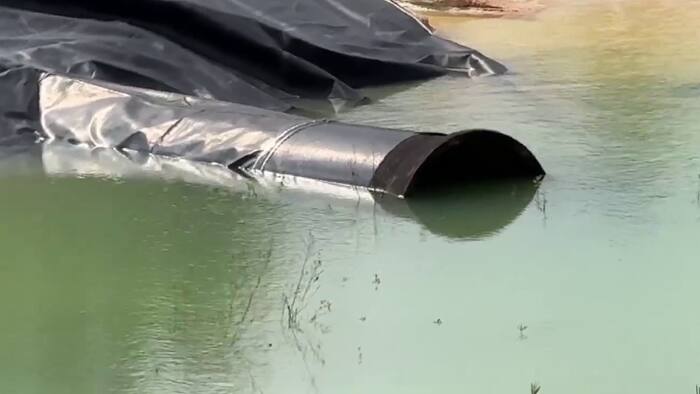
At Golden Gem, construction is underway on a pump station intended to help connect the city’s reclaimed-water storage capacity to the larger distribution network.
According to Apopka’s published wastewater and reclaimed-water history, the city completed a 300-million-gallon holding pond along Golden Gem Road in 2021.
The current improvements are intended to help the city put that large storage resource to more effective use.
Brooks told News 6 that once the facility is fully operational, the system will have access to a little more than 300 million gallons of additional storage capacity.
That is enough water to equal the daily household usage of roughly 900,000 average American households, although Golden Gem’s water is reclaimed water intended for uses such as irrigation, not household drinking water.
The project also includes new pumping capabilities and is associated with planned improvements to large transmission pipes needed to move water away from Cleveland Street.
Brooks discussed a 30-inch pipeline extension intended to help alleviate one of the bottlenecks.
“So once this facility is up and running, the one thing is, it’d be great, this is giving us 300, a little over 300 million gallons of extra storage,” Brooks said.
The goal is to move excess reclaimed water into storage when it is available, then distribute that water more effectively when demand increases.
The system should also give utility operators greater flexibility during periods when water supplies and irrigation demands do not align.
“Once we have this facility up and running, we’re gonna be able to meet that demand,” Brooks said.
Simonovski said construction on the current project began in September and is expected to take approximately 18 months, putting the anticipated completion around spring 2028 if the schedule holds.
The project is part of a larger regional effort that Simonovski said has received support over time from the Florida Department of Environmental Protection and the St. Johns River Water Management District.
How this connects to another nearly $6 million Apopka water project
The Golden Gem construction also connects to another major reclaimed-water infrastructure story News 6 reported just last week.
On October 30, News 6 detailed how Apopka secured a $5,784,615 state grant to construct approximately 5,600 feet of new 30-inch reclaimed-water transmission pipe along Plymouth Sorrento Road.
The project will run between West Lester Road and West Ponkan Road, connecting existing sections of the system and creating a more continuous route for reclaimed water to move through northern Apopka.
City officials previously confirmed that the pipeline will help move water toward the Golden Gem facility and storage tanks at the Northwest Recreation Center.
The city says the improved transmission capacity is expected to help replenish those storage facilities during periods of heavy irrigation demand.
Although the state-funded pipeline and the current Golden Gem construction are separate infrastructure projects, both are part of Apopka’s broader effort to improve storage, distribution and reliability.
In last week’s reporting, Apopka Mayor Nick Nesta acknowledged that some northern neighborhoods have struggled with reclaimed-water pressure for years.
“We have plenty to serve our residents. We just have choke points,” Nesta told News 6.
He described an aging system that had not adequately kept pace with the city’s population growth.
Among the communities expected to benefit from the Plymouth Sorrento Road pipeline improvements are Wekiva Run, Ridgebrook and Rock Springs Ridge.
In Rock Springs Ridge, homeowner Linda Matthews previously described how inconsistent irrigation pressure has made it difficult to maintain her lawn.
“Just spray the lawn green. Just paint it, you know?” Matthews joked during an earlier News 6 interview.
The newly funded pipeline is scheduled to begin construction in September 2027, with completion anticipated in May 2028.
The state grant covers the full cost of that particular project, according to Apopka. It does not change the city’s previously approved utility-rate increases.
Why reclaimed water matters beyond irrigation
Although the disagreement between Apopka and Altamonte Springs centers on the movement of reclaimed water, officials emphasize that the regional system serves a broader environmental purpose.
Reclaimed water is wastewater that has undergone treatment so it can be reused for approved non-drinking purposes, particularly irrigation.
Rather than drawing additional freshwater from underground aquifers to water lawns and landscaping, communities can use properly treated reclaimed water.
That matters in Central Florida, where groundwater is an important source of drinking water and continued development increases demand.
Simonovski explained that Apopka’s growing neighborhoods require more reclaimed water than the city currently produces on its own.
That is why agreements with neighboring utilities are important.
“That excess water is used to irrigate all the new developments in town. So basically it helps not withdrawing water from the aquifer, saving the aquifer,” Simonovski said.
By accepting excess water from Altamonte Springs and other regional partners, Apopka can reduce its reliance on groundwater for irrigation.
Meanwhile, the participating cities gain another way to manage treated water that might otherwise need to be discharged or handled through other means.
The improvements are also intended to strengthen regional water management at a time when Florida continues to experience significant growth.
Altamonte Springs city manager confirms relationship has improved
Perhaps the most significant development in the dispute is that officials from both cities now say they are working together.
Following Wednesday’s interviews in Apopka, News 6 spoke directly with Altamonte Springs City Manager Frank Martz, who confirmed that the relationship has improved since the January letter.
Martz said he has been communicating frequently with Apopka Mayor Nick Nesta and that officials from the two cities have held multiple meetings to address the situation.
“We have met several times. We have a clear understanding of what they’re doing,” Martz told News 6.
According to Martz, Altamonte Springs is now closely coordinating with Apopka while infrastructure improvements are underway.
He said the cities have developed a better understanding of the work necessary to address the operational challenges and how the water-sharing arrangement will function during construction.
“I think our teams are working very well together,” Martz said.
That assessment closely matches what Brooks told News 6 earlier in the day.
Brooks described the discussions between Apopka and Altamonte Springs as productive and said the relationship has improved considerably in recent months.
“We’ve had really productive meetings over the last couple, three months,” Brooks said.
Martz also expressed confidence that Apopka will ultimately fulfill its obligations under the agreement.
However, neither the interviews nor the January letter establishes that the disagreement has been formally settled or that Apopka’s infrastructure has already achieved the intended delivery capacity.
For now, both cities say they are focused on cooperating while construction continues.
Martz characterized the larger project as an example of how communities can work together across county lines to address infrastructure challenges.
“It’s a great example of governments even in other counties, in different counties, working together to try to solve problems but at the same time save money and create resources,” Martz said.
What happens next?
For the people who depend on Apopka’s reclaimed-water system, the ultimate measure of success will not be the number of meetings between city officials or the size of a new pumping facility.
It will be whether water can reliably reach the neighborhoods that need it.
The Golden Gem improvements are expected to strengthen the system’s ability to receive, store and distribute reclaimed water.
The separately funded Plymouth Sorrento Road pipeline is designed to address another existing distribution bottleneck.
Together, the projects represent substantial infrastructure investments intended to improve the system’s performance as Apopka continues to grow.
But the work is not complete, and the precise extent of future improvements will depend on construction, system performance and the cities’ continued coordination.
For Altamonte Springs, the goal remains consistent reclaimed-water deliveries under the long-standing agreement.
For Apopka, the goal is a system capable of accepting that supply and distributing it without exceeding operational limits.
And for residents, the payoff could be more reliable irrigation water and less pressure on the groundwater resources Central Florida depends on.
After years of infrastructure challenges and months of strained relations, the two cities now appear to share the same objective: making a regional water-sharing system work the way it was intended.
Additional information and resources:
- City of Apopka: History of Wastewater and Reclaimed Water
- City of Altamonte Springs: A-FIRST Regional Water Project
- Florida Department of Environmental Protection: Alternative Water Supply
- Florida DEP: October 28, 2026, announcement of $100 million in water infrastructure funding
- News 6: Nearly $6 million grant to improve Apopka’s reclaimed-water pressure