
Dollars & Sense: Your credit score has competition
What to Know:
- FICO isn’t the only game in town. There is another system that can be used to determine your credit score.
- VantageScore is used by lenders to evaluate consumers applying for credit cards, auto loans, mortgages, and other loans.
- Consumers can have multiple credit scores, and the differences between them can be significant.
ORLANDO, Fla. – You’ve heard of FICO.
For decades, it’s been the dominant credit-scoring system used by lenders to evaluate consumers, producing a three-digit score ranging from 300 to 850.
Here’s how FICO classifies those scores:
- 300-579 Poor
- 580-669 Fair
- 670-739 Good
- 740-799 Very Good
- 800-850 Exceptional
The higher your score, the more creditworthy you’re generally considered, which can influence everything from whether you’re approved for a loan to how much interest you’ll pay. But did you know there’s another major credit-scoring system competing for lenders’ business?
It’s called VantageScore, and it’s hardly the new kid on the block. Developed by the three major credit bureaus – Equifax, Experian, and TransUnion – VantageScore has been around since 2006.
Like FICO, VantageScore generally assigns consumers a number between 300 and 850. But the two systems use different scoring formulas, meaning the same person can receive different scores depending on which model is used.
And while VantageScore has been used in credit-card, auto, and other lending decisions for years, it’s now making significant inroads into a market where FICO has long dominated: mortgages. That growing competition raises an important question for consumers: If two scoring systems can evaluate the same financial history differently, could the one your lender chooses determine whether you qualify for a loan – and how much it costs you?
Some Distinctions and Terminology
Before going any further, it’s important to understand a few distinctions, starting with the difference between a credit report and a credit score.
Your credit report is essentially a record of your credit history. It contains information about your credit accounts, payment history, outstanding balances, and other details lenders report about how you’ve managed borrowed money. The three major credit bureaus – Equifax, Experian, and TransUnion – collect and maintain that information. Because creditors don’t necessarily report to all three bureaus, the information in your credit reports may differ.
Your credit score, on the other hand, is a numerical assessment of your creditworthiness, calculated using information from those reports. Think of your credit report as the information going into the calculation and your credit score as the number coming out.
That’s where FICO and VantageScore come in.
Although both systems use information from consumers’ credit reports, their different scoring formulas can produce different scores from the same financial information. And here’s something else consumers may not realize: you don’t necessarily have just one FICO score and one VantageScore. Both companies have developed multiple scoring models, and scores can also vary depending on which credit bureau supplies the information. That means you could have numerous credit scores, all of them legitimate.
There’s another important distinction: neither FICO nor VantageScore decides whether you’re approved for credit. Lenders make those decisions, using credit scores alongside other information, such as your income, existing debt, and employment history. In other words, the credit bureaus maintain your credit reports, FICO and VantageScore provide the scoring models, and lenders decide whether to extend credit.
FICO vs. VantageScore: So What’s the Difference?
At their core, FICO and VantageScore are trying to accomplish the same thing: predict how likely you are to repay borrowed money. Both analyze information from your credit reports, including your payment history, outstanding debt, length of credit history, and applications for new credit.
But they don’t necessarily evaluate that information the same way.
FICO places considerable emphasis on your payment history, which accounts for approximately 35% of a traditional FICO Score. The amount you owe makes up another 30%, while the length of your credit history, new credit, and types of credit accounts make up the rest.
VantageScore considers many of those same factors but weighs and analyzes them differently. Its VantageScore 4.0 model also considers trends in your credit behavior over time, rather than relying solely on a snapshot of your financial situation.
For example, consistently paying down credit-card balances may tell a different story about your financial health than carrying the same balance month after month. Those differences mean two scoring systems can examine the same credit history and produce different results. And depending on the lender and the type of loan, those differences could matter.
What Happens When Your Credit Scores Don’t Match?
The short answer: it depends on which score your lender uses.
You might check your credit score through your bank or a credit-monitoring service and see a number you’re perfectly happy with. But when you apply for a credit card, car loan, or mortgage, the lender could be looking at a different score.
That’s because lenders aren’t required to use the same scoring model, and the score they choose may produce a different assessment of your creditworthiness.
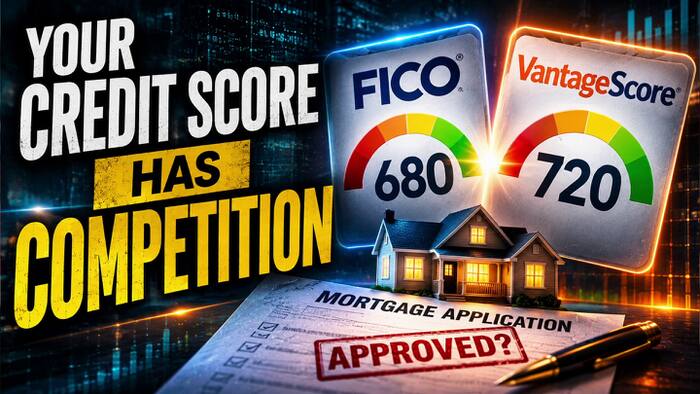
So, what happens if one model gives you a score of 680 and another gives you a 720?
Potentially, quite a bit, but those numbers aren’t directly interchangeable because each model evaluates credit risk differently.
Lenders establish their own credit requirements, and a difference in scores could influence whether you’re approved, the interest rate you’re offered, or other terms of the loan. But there’s an important catch: a higher score under one model doesn’t automatically mean you’ll qualify for better terms. Lenders may interpret scores differently depending on the model, and they consider other financial information when making lending decisions.
And while you can monitor your credit scores, you generally can’t dictate which scoring model a lender uses. That means the score you’re watching may not be the one your lender considers when deciding whether to approve your application or what interest rate to offer.
The Mortgage Industry Shake-Up
For decades, FICO has enjoyed a virtual monopoly in one important corner of the lending industry: mortgages backed by Fannie Mae and Freddie Mac.
But that’s changing.
In April 2026, the Federal Housing Finance Agency (FHFA), which oversees Fannie Mae and Freddie Mac, began allowing participating lenders to use VantageScore 4.0 instead of the traditional FICO model when originating eligible mortgages. Then, on September 9, the agency expanded that option to all approved lenders, giving them a choice between the two scoring models.
That’s significant because Fannie Mae and Freddie Mac purchase mortgages from lenders, helping provide the money those lenders need to make additional home loans.
And the change is already gaining traction.
According to Fannie Mae, 37% of conventional mortgage applications created in its Desktop Underwriter system in September 2026 included a VantageScore 4.0 credit score. The newer model can also incorporate eligible rent-payment information when it’s included in a consumer’s credit report, potentially helping some borrowers whose financial responsibility isn’t fully reflected in traditional credit scores.
But there are limits. Lenders aren’t required to use VantageScore, and a higher score under the newer model doesn’t guarantee mortgage approval or better borrowing terms. And VantageScore isn’t alone in examining credit trends over time. FICO has developed a newer model, called FICO 10T, which also analyzes changes in consumers’ credit behavior.
Still, for consumers, the development means the credit-scoring model used to evaluate a mortgage application is no longer necessarily the one that’s dominated the industry for decades.
What Does This Mean for Your Credit?
For consumers, the growing competition between FICO and VantageScore doesn’t mean you need to start chasing two different credit scores, but it does mean you should understand which score a lender is using, especially before applying for a major loan.
Here are a few things to keep in mind:
- Know which score you’re looking at: The score provided by your bank, credit-card company, or credit-monitoring service may not come from the same scoring model a lender uses. Check whether it’s a FICO Score or VantageScore, and which version you’re seeing.
- Ask lenders which scoring model they use: Before applying for a mortgage, auto loan, or other credit, ask which model the lender uses to evaluate applicants. You generally can’t choose the model yourself, but knowing which one is being used can help you better understand your options.
- Check your credit reports for errors: Both scoring systems rely on information from your credit reports. You can review your reports from Equifax, Experian, and TransUnion for free at AnnualCreditReport.com.
- Don’t abandon good credit habits: Paying bills on time, keeping credit-card balances low, and avoiding unnecessary debt remain important regardless of which scoring model a lender uses.
- Shop around: Different lenders may use different scoring models and lending criteria. Comparing offers can help you find better terms, even when your credit history remains the same.
And remember, a higher credit score doesn’t automatically guarantee approval or a lower interest rate. Your income, existing debts, and other financial information still play a role. The bottom line: FICO and VantageScore may be competing for lenders’ business, but consumers have something at stake, too.
Knowing which credit score your lender uses, understanding why it matters, and comparing your borrowing options could make a difference the next time you apply for credit.